Who Simms is
Simms started in 1980 as a wader company. According to Wikipedia, it was founded by John Simms, a fishing guide and outfitter in Jackson, Wyoming, who wanted better waders than the market offered, and in the mid-1980s it brought high-quality neoprene waders to the US market. It was later sold to Life-Link International, another Jackson company, and then to K.C. Walsh, a Los Angeles management consultant who moved the business to Bozeman, Montana, where the headquarters remains. Wikipedia gives 1992 for that purchase, and other accounts give 1993, so I am calling it the early 1990s rather than picking one. Breathable waders using GORE-TEX followed shortly after the move.
Ownership has changed again since. Vista Outdoor held Simms through its Revelyst unit, which Vista agreed to sell to Strategic Value Partners in October 2024, and trade press reported the purchase complete on January 6, 2025, with Simms among Revelyst's brands. I did not find a more recent primary statement, so treat that as the latest I could confirm.
What Simms sells on Amazon US now
At our last check (October 2026) we track 29 Simms products on Amazon US. There are seven waders (Freestone, Freestone Z, Tributary, in men's, women's and kids' versions), seven wading boots, four pairs of wading socks, three belts, a folding wading staff and seven packs and vests. The table above lists them all with the values we could confirm. "Maker" under a value means Simms states it on its own page, "listing" means the Amazon listing says so, and a dash means we could not confirm it anywhere.
The names you hear most are not here. The G3 Guide and G4 waders, which many anglers search for, are not in our Amazon data, though the G3 Guide boot is. That is not a comment on the waders. It means the Amazon listings we could confirm do not include them, and I would rather say that than sell you a spec sheet for a pair you cannot buy through this page.
The wader lines and who each suits
Freestone. The men's and women's Freestone stockingfoot are listed as breathable, 4-layer waders with reinforced knees and a convertible chest-to-waist design (those three come from the Amazon listing). The men's pair is listed at 42 oz and the women's at 40.2 oz. They suit general trout water in cool or mild weather where you want a stockingfoot that pairs with a separate boot. See our stockingfoot waders page for how that setup works.
Freestone Z. The same 4-layer idea with a front zipper, in stockingfoot (44.9 oz) and bootfoot (110.8 oz). The zipper is the point of the model, and the cost is a couple of ounces and one more part that can fail. If you are weighing bootfoot against stockingfoot, our bootfoot waders page has the trade-offs. I'd choose the stockingfoot if you walk and the bootfoot if you mostly stand.
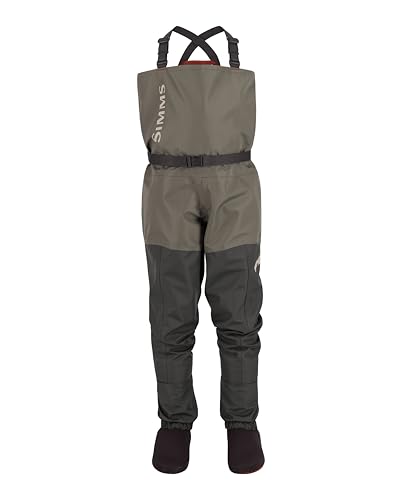
Tributary. The lighter family: the men's stockingfoot lists 32.7 oz, the women's 31.1 oz and the kids' pair 23.1 oz, all with built-in gravel guards. It is the entry line in our data, with no layer count listed. It suits shorter trips, warm weather and anyone who wants the lowest weight. If a child is going in the water, our kids waders page covers fit and safety.
I'll add one honest note. Simms makes more wader models than appear here, and the table covers what we found on Amazon US, not the whole catalog.
Boots, socks, belts, staff and packs
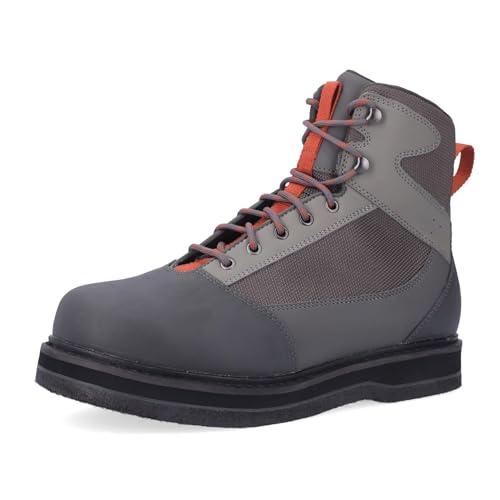
Boots. The Freestone boot comes in men's and women's sizes with a rubber or a felt sole, laces and stud compatibility, listed at 51 to 58 oz per pair. The Tributary boot is unisex in sizes 4 to 15, in rubber or felt. The G3 Guide Vibram is the heavy one at about 77.8 oz per pair. (Naming a boot "Guide" is a model name, not a credential.) Felt grips slick rock and is restricted in some places, so check the rules for your water, then read our felt vs rubber wading boots guide and the felt sole page.
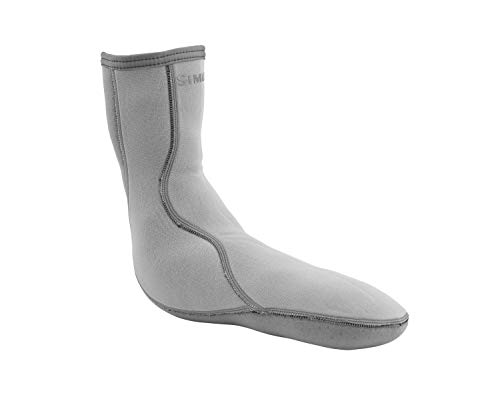
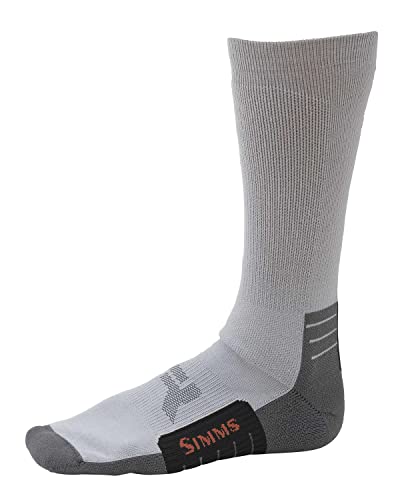
Socks. The Guide Guard (3.5 mm neoprene with a gravel guard), the Neoprene Flyweight (2.5 mm with a gravel guard), a plain 2.5 mm neoprene sock and a synthetic-knit Guide Wet Wading Sock. See neoprene wading socks for how thickness affects boot fit.
Belts. A 1.5 in elastic belt listed to a 52 in waist, a 2 in elastic belt (listing) and a 2 in neoprene belt. A belt is not an extra, and our wading belts page explains why I'd wear one every time.
Staff. A folding aluminum staff the maker lists at 54.75 in with a holster. A staff is safety equipment, and it works best with a belt and a plan for each crossing. See wading staffs.
Packs and vests. A Guide Vest (26 pockets, 19 oz per maker), a Tributary sling pack (9 L, 15.9 oz) and a chest pack (3.5 L), a Dry Creek rolltop backpack and three more vests. See sling packs and fly fishing vests for what to look for.
How to read the table
Waders have the columns Model, Height, Foot, Material type, Insulation, Fit, and Warranty. For Simms, a few reminders. Height is often "convertible" in the listing, which means it can fold to waist height, and it is marked "listing" because the maker's page does not always say so. Insulation shows a dash where we could not confirm it, and I'd read a dash as "not confirmed", not as "none". Warranty is the maker's wording when we found it.
Sizing: how to buy Simms waders and boots
Simms sizes waders by three measures: your largest girth, your inseam (crotch to floor) and your stockingfoot bootie size. The chart notes that not every model comes in every size, and that some larger sizes are available only through its Custom Shop. Measure yourself, then check the chart for your model. Our Simms wader size chart guide walks through that, and our wader size chart guide covers the general method. I'm not copying the chart.
Boots are the other half. Simms says most people go from their street size up to one full size, and half sizes should go up. Size up too far and the heel lifts, and too small leaves no room for the neoprene. Try boots with the socks and waders you will actually wear. Our data shows women's sizing in Freestone from 5 to 12 and men's from 5 to 16.
Warranty
The Simms warranty page sets out three layers. Defects in workmanship or materials are repaired or replaced. Waders that leak in the first 60 days are replaced, and repairs in the first 365 days are free. After the first year, repairs are done for a flat fee covering evaluation, repair, testing and return shipping. Excessive wear and accidents such as barbed wire or a campfire are handled on a repair-for-fee basis, not as warranty. Bought direct, you start the claim on the online repair page and pay to send the waders in; bought from an authorized dealer, you return them there with proof of purchase. Turnaround is typically about three weeks.
The Amazon data for many Simms items calls this a "lifetime guarantee." The wording on the warranty page itself describes the windows above, so read the policy for your item, and keep the receipt somewhere you can find it in year two. Our Simms wader warranty guide covers claims in detail, and the Simms wader repair guide covers the repair route.
Who should skip Simms
Simms is a sensible brand for people who care about fit options and written terms, and a poor fit for anyone shopping on the lowest price tier alone. Our table shows the Tributary at the lighter end, but it does not list a layer count, so ask what you are giving up before you choose it. If you want the lowest possible cost per season, a budget wader will do the job for a few seasons and you can read our waders hub to see how that trade-off works. If you want a particular model that is not in the table, such as a G3 Guide, buy it where you can confirm the exact version. And if you wade in cold water for hours, look at the insulated waders page, because none of the Simms waders in our data lists insulation.