How this list is builtWaders whose maker publishes construction, foot type, warranty and fit options (short, long, king…), so you can match them to your body and season.
We earn a commission if you buy through our links, at no cost to you. Disclosure
| Model | Height | Foot | Material type | Insulation | Fit | Warranty | Amazon |
|---|---|---|---|---|---|---|---|
Avery Originals 5mm Neoprene WaderWaders More specs
| Chestlisting | Bootfootmaker | Neoprenemaker | 1,600 g bootsclaimed | Men'slisting | 1-year warranty for manufacturer defectmaker | See it on Amazon |
Avery Originals Breathable Insulated WC WaderWaders More specs
| Chestlisting | Bootfootmaker | Breathablemaker | 1,600 g bootsclaimed | Men'slisting | 1-year warranty for manufacturer defectmaker | See it on Amazon |
Avery Originals Breathable Uninsulated WC WaderWaders More specs
| Chestlisting | Bootfootmaker | Breathablemaker | 1,600 g bootsclaimed | Men'slisting | 1-year warranty for manufacturer defectmaker | See it on Amazon |
Banded Black Label Elite Insulated WaderWaders More specs
| — | Bootfootmaker | Breathablemaker | 1,600 g bootsclaimed | Men'smaker | 2-year full wader warrantymaker | See it on Amazon |
Banded Black Label Elite Zipper Uninsulated WaderWaders More specs
| Chestlisting | Bootfootmaker | Breathablemaker | 1,600 g bootsclaimed | Men'smaker | 2-year full wader warrantymaker | See it on Amazon |
Banded Phantom X Breathable Insulated WaderWaders More specs
| Chestlisting | Bootfootmaker | Breathablemaker | 1,600 g bootsclaimed | Men'smaker | 2-year warrantymaker | See it on Amazon |
Compass 360 Deadfall STFT WaderWaders More specs
| Chestlisting | Stockingfootmaker | Breathablemaker | — | Men'smaker | 1 yearmaker | See it on Amazon |
Drake Waterfowl BMF1600 Kevlar WaderWaders More specs
| Chestlisting | Bootfootmaker | Breathablemaker | 1,600 g bootsclaimed | Men'slisting | 4-year (Drake wader warranty)maker | See it on Amazon |
Drake Waterfowl Buckshot Eqwader 1600 Neoprene Wader 3.0Waders More specs
| Chestlisting | Bootfootmaker | Neoprenemaker | 1,600 g bootsclaimed | Men'slisting | 3-year (Drake wader warranty)maker | See it on Amazon |
Drake Waterfowl Hybrid Insulated Guardian Elite HND Front Zip WaderWaders More specs
| Chestlisting | Bootfootmaker | Breathablemaker | 1,600 g bootsclaimed | Men'slisting | 3-year (Drake wader warranty)maker | See it on Amazon |
Frogg Toggs Amphib 3.5mm Neoprene Bootfoot Chest Wader (Mossy Oak Bottomland)Waders More specs
| Chestlisting | Bootfootlisting | Neoprenemaker | 600 g bootsclaimed | Men'smaker | 1 yearmaker | See it on Amazon |
Frogg Toggs Amphib Neoprene Cleated Bootfoot Chest WaderWaders More specs
| Chestlisting | Bootfootlisting | Neoprenemaker | 200 g bootsclaimed | Men'slisting | 1 yearmaker | See it on Amazon |
Frogg Toggs Amphib Neoprene Stockingfoot Chest WaderWaders More specs
| Chestlisting | Stockingfootlisting | Neoprenemaker | — | Men'slisting | 1 yearmaker | See it on Amazon |
Paramount Outdoors Deep Eddy Zippered Breathable Stockingfoot Chest WaderWaders More specs
| Chestmaker | Stockingfootmaker | Breathablemaker | — | — | 1 year (defects in materials and workmanship)maker | See it on Amazon |


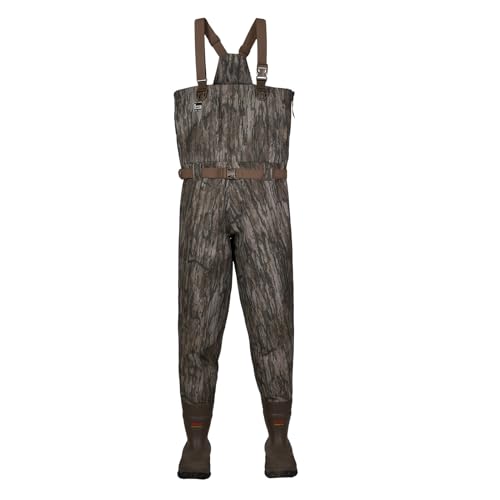


Notes on each pick
What this list is, and the rule behind it
A list called "best waders" invites a ranking by feel, and I can't do that honestly. We do not test waders. What we can do is apply a written rule to published data, show the rule, and let you check it.
The rule on this page: a pair is included if its maker publishes the construction, the foot type, the warranty and the fit options (short, tall, stout, king and so on). I chose those four because they are the things that decide whether a pair will work for you. Construction tells you how it handles warmth and breathability. Foot type tells you whether you need a separate boot. Warranty tells you what the maker stands behind. Fit options tell you whether the pair is made for a body like yours. A pair that does not publish those is not a worse wader. It is a pair we cannot describe fully, and I'd rather leave it off than guess.
The rule gives 15 pairs at our last check, with at most three from any one brand so that no maker's range fills the page. It leaves out many waders that may be good, because their makers publish less or because the cap trimmed a longer range. That means a few brands you might expect to see are absent, and a few models from the brands that are here. Their absence is not a verdict. Pairs enter and leave this list as availability changes each week, so the count can shift.
What the list looks like
Three things stand out, and they matter more than any single pair.
It still leans toward hunting. Nine of the pairs come from Avery, Banded and Drake, which list hunting waders, and two Frogg Toggs pairs are labeled for fishing and hunting. (Camouflage pattern is a spec too, though I have yet to meet a fish that cared.) The Compass 360 Deadfall is listed for fly fishing, the Paramount Deep Eddy pairs for general fishing and the Frogg Toggs stockingfoot for fishing. If you fish and do not hunt, this list is a starting point and not the whole answer. The best fly fishing waders page uses a different rule.
It is mostly bootfoot. Eleven of 15 have the boot attached. Boot insulation runs from 200 g on one Frogg Toggs pair to 1,600 g on the hunting pairs, which is heavy-duty winter gear at the top. The four stockingfoot pairs are the Compass 360, the Frogg Toggs Amphib and the two Paramount Deep Eddy waders. If you walk a lot, the stockingfoot waders page lists more pairs that do not meet this page's rule but may suit you.
Warranty ranges widely. Within the list the warranty runs from one year (Avery, Compass 360, Frogg Toggs and Paramount) to two years (Banded), three years (the other Drake pairs) and four years (the Drake BMF1600). Read the exact wording. One Banded pair lists a two-year "full wader warranty", and the Paramount pairs word theirs as covering defects in materials and workmanship. My view, and it is only my view, is that the warranty is part of what you are buying.
How to read the table
The table above carries the specs. The marks to know: maker means the value comes from the manufacturer's page, claimed marks a maker's own claim with no independent lab named, listing means the Amazon listing says it and the maker's page does not confirm it, and — means not confirmed. Wader height and gender fit come from the listing for many pairs here, so treat them as the listing's statement.
The columns that matter on this list:
- Construction and layers. Ten are breathable and five are neoprene (the Avery 5 mm, the Drake Buckshot Eqwader and the three Frogg Toggs Amphib pairs). Layer counts are the maker's number: the Banded Black Label Elite pairs list five layers, the Phantom X lists three, and the Compass 360 and the Paramount Deep Eddy pairs list four. A bigger number is not a durability grade, and makers count differently.
- Insulation. Boot insulation is given in grams. Some pairs also list body insulation (HARS, a hybrid), and the neoprene pairs list millimeters. A pair called "uninsulated" can still have 1,600 g in the boot, which is how the data reads for the Avery Originals Breathable Uninsulated.
- Warranty. The term in years, as the maker words it.
- Sizes. The size options. Boot size is often separate from body size, and you choose both.
Choosing between them
Start with temperature. If you will be in cold water or a cold blind, pick an insulated pair: the Avery neoprene and insulated breathable, the Banded Black Label Elite Insulated and Phantom X Insulated, the Frogg Toggs Amphib 3.5 mm, or the Drake Hybrid. The Banded Phantom X Insulated is the only pair here where the maker states a body comfort rating on the page: minus 10 to 50 degrees Fahrenheit. Comfort ratings are claims, and they assume what you wear underneath.
Then choose breathable or neoprene. Breathable pairs let moisture escape, so they are better if you walk or work. Neoprene is warmer in cold water and tough around brush, but it runs hot and humid when you move. Our guide to breathable vs neoprene waders has more detail, and the neoprene and breathable pages list pairs beyond this rule.
Check the body options. The Banded Phantom X lists Slim, Regular, Stout and King, with boot sizes 5 to 18. Drake lists Regular and Stout on some pairs and Tall on others. Avery lists Regular and Stout, Frogg Toggs lists Husky sizes on the Amphib bootfoot and Stout on the stockingfoot, and Paramount lists Stout up to 4XL on the Deep Eddy. If you are a big guy, the useful question is whether the maker lists a stout or king body at the boot size you need, not whether the pair is called heavy-duty. Our wader size chart guide explains the labels.
Look at the zip. A front zip makes getting out of chest waders easier. The Banded Black Label Elite Zipper, the Drake BMF1600, the Drake Hybrid and the Paramount Deep Eddy Zippered list one. A zip is another part that has to hold, and I would read the maker's care instructions before buying.
Think about the foot. Bootfoot is simple and warm. Stockingfoot, like the Compass 360, the Frogg Toggs Amphib stockingfoot and the Paramount Deep Eddy pairs, requires you to buy wading boots but gives you more control over fit and traction.
Here is the scale nobody wanted: the Wet Sock Index runs from damp suspicion to you are now part of the river, and not one pair on this list has been measured against it by us, or, as far as I can tell, by anyone who publishes the number. Warranty length is the nearest thing I can offer.
Reading the insulation numbers
Insulation figures are the easiest numbers on this list to misread. A boot figure such as 1,600 g describes the insulation in the boot, not the whole wader, and the body of the same pair may be insulated, partly insulated or not at all. The Drake Hybrid lists insulated legs and a non-insulated upper. The Frogg Toggs Amphib Cleated lists a 200 g boot under 3.5 mm neoprene, while the Amphib in Mossy Oak lists 600 g. The Banded Black Label Elite page gives no comfort rating at all. When a maker gives a temperature range, as Banded does for the Phantom X, it is a claim about a typical wearer, and what you wear underneath changes it.
The practical rule: choose insulation for the coldest day you will stand still, and choose breathability for the warmest day you will walk. If both describe your season, an uninsulated breathable pair with warm layers underneath is more flexible than a heavily insulated one, though it asks you to manage your layers.
Fit labels on this list
The labels you will meet here are Regular, Stout, King, Short and Tall, and makers do not define them the same way. As the retail fit guides I read describe it, Short, Regular and Tall (or Long) refer to leg length, and Stout and King are for bigger builds, with King cut wider through the chest and waist. Banded's size chart lists Slim, Regular, Stout and King as separate groups with their own measurements, and Drake lists Tall as a length option on its upper sizes, and Frogg Toggs and Paramount use Husky and Stout labels. Do not shop by the label alone. Measure yourself and read the chart for the exact pair.
Boot size matters just as much on a bootfoot wader, because the boot cannot be swapped. The boot sizes on this page start at 5 for the Phantom X, 7 for Frogg Toggs and 8 for most of the rest, and run up to 18 on the Phantom X. If you are between boot sizes, SITKA's advice for bootfoot waders is to size up and leave room for socks.
What a list like this cannot tell you
The rule tells you what a maker publishes. It cannot tell you how long a pair will last, how often it leaks, or how good the maker's service is when something goes wrong. Buyer reviews on Amazon can speak to those things, but I have not summarized them for these pairs, and I would not turn them into scores anyway. Treat the sizing notes as maker data only.
Before the first trip, try the pair on at home with the layers you plan to wear, put a little weight through each foot, and check the seams, zip and knees. If something is wrong, that is the moment to return it, not in the middle of a river. Keep the receipt where you can find it, because warranties often ask for proof of purchase.
More specific searches
Your search is probably narrower than "best waders". A few pointers:
- Fishing: best fly fishing waders and the chest waders page.
- Hunting: duck hunting waders and hunting waders.
- Cold weather: insulated waders.
- Budget: the budget waders page applies a price-tier rule, which this one does not.
- Women, men or kids: women's, men's and kids pages.
- Hip or waist height: hip waders and waist waders.
- Surf and saltwater: none of the pairs here are stated by their makers as saltwater waders, so I will not point you at one. Check the listing for the pair you want.
Sizing and safety
Waders fit through measurements: chest, waist, inseam and shoe size. SITKA's guide advises sizing up if you are between sizes on bootfoot waders, and trying them on with the socks and layers you will wear. Do a deep knee bend, sit down and raise your knees; you should not feel significant pulling. If you cannot try them on, use the maker's chart and read our size chart guide.
I have not summarized buyer fit feedback for these pairs, so the sizing notes in the verdicts report only the sizes the makers list. Whatever you buy, wear a snug wading belt over chest waders and carry a wading staff in current. The Orvis wading guide names the belt, next to a life jacket, as the most important piece of gear to wear with waders. See wader care and storage for making a pair last.
Brands in this table
Related
Questions people ask
What are the best waders?
There is no single answer, and this page does not name one. It lists the pairs that meet a written rule: the maker publishes the construction, the foot type, the warranty and the fit options. Within that list, the best pair for you is the one whose size options match your build and whose insulation matches your water.
Are these the best fishing waders?
Some of them can fish. The Compass 360 Deadfall is listed for fly fishing, the two Paramount Deep Eddy pairs are labeled for general fishing, and the Frogg Toggs Amphib pairs are labeled for fishing, hunting or both. The Avery, Banded and Drake pairs are mostly hunting waders. For a fishing-first list, see our best fly fishing waders page.
What are the best waders with boots?
Eleven of the 15 pairs on this page are bootfoot, which means the boot is attached. The boot insulation figures in our data run from 200 g on one Frogg Toggs pair to 1,600 g on most of the hunting pairs, and the higher figures suit cold water and standing for long periods more than long hikes. Bootfoot pairs from other brands are on the bootfoot waders page.
What is the best breathable chest wader here?
Ten of the 15 pairs are breathable in the maker's description, from the Avery and Banded SHEDS-membrane waders to the Drake Hybrid Guardian Elite, the Paramount Deep Eddy pairs and the Compass 360 Deadfall. The other five are neoprene. Which one is best for you depends on whether you want insulation, a front zip, a longer warranty or a stockingfoot design.
Which waders here are best for cold water?
Look at the insulation figures and the comfort rating where the maker states one. The Banded Phantom X Insulated lists a comfort rating of minus 10 to 50 degrees Fahrenheit, and it is the only pair here with one. Other pairs list boot insulation in grams, or neoprene thickness, but no body comfort rating. Comfort ratings are maker claims and depend on what you wear underneath.
What size should I buy?
Use the maker's chart for the exact pair, because sizes differ between models. Waders on this page come with boot sizes plus body sizes or fit options, so you choose two things. Our wader size chart guide explains how to measure.
Sources
- Banded: Phantom X Breathable Insulated Wader — accessed 2026-10-15
- Drake Waterfowl: BMF1600 Kevlar Wader — accessed 2026-10-15
- Compass 360: Deadfall STFT Wader — accessed 2026-10-15
- SITKA: What size waders do I need — accessed 2026-10-15