The short answer
Choose Skagit if you want to throw heavy sink tips and large flies, or if you are new to two-handed casting. Choose Scandi if you fish smaller flies on a floating line or a light tip, in clear low water, and you are willing to learn a longer stroke. That is the whole choice, and the rest is detail about length, taper and mass.
Both are heads for spey rods: a short section of fly line, the part that does the casting, attached to thin running line. On our site they sit under fly lines, and the rods they go with are on the spey rods page. If the basics are new, what is a spey rod comes first.
Skagit heads
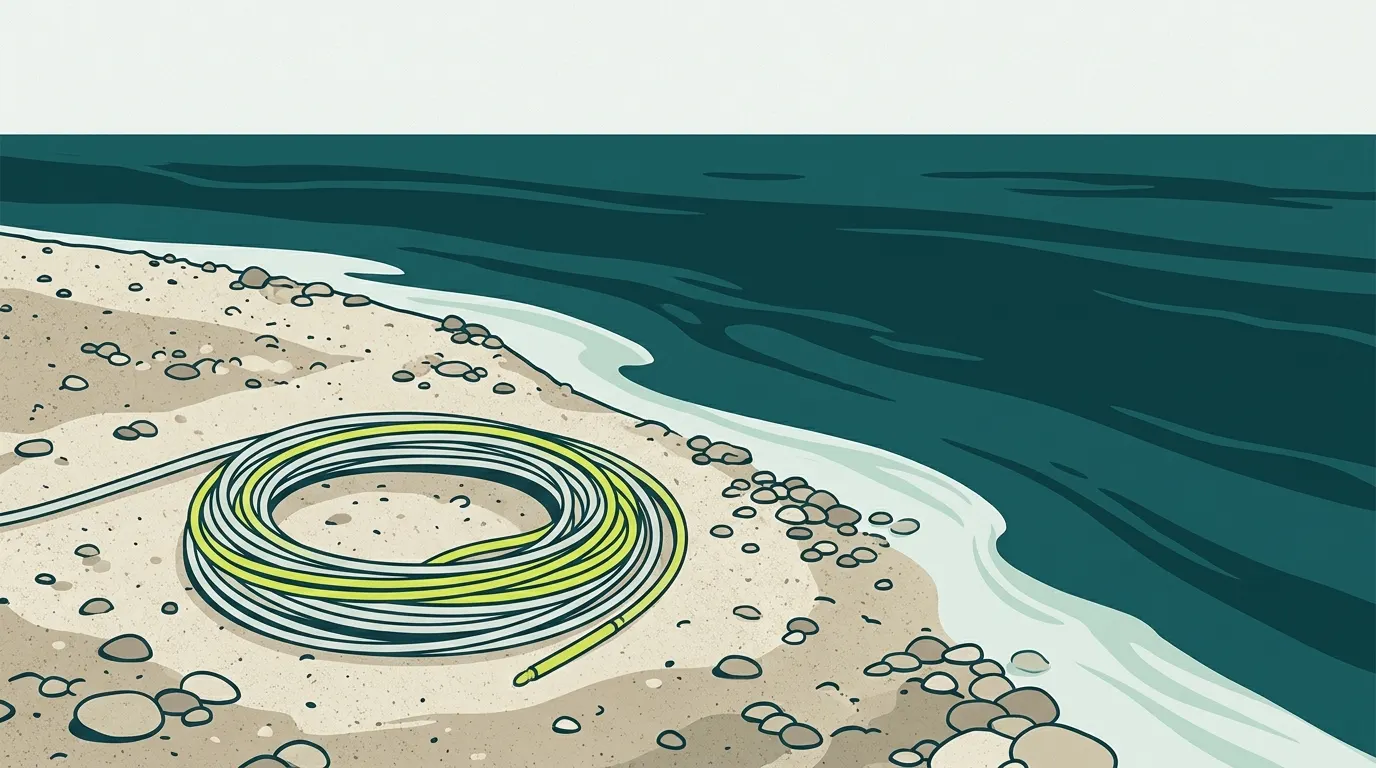
Skagit heads are short and heavy. Fly and Field gives a head length of 15 to 25 feet and describes the shape as a long body with a short front taper. Big Sky Anglers, writing about trout spey, gives 12 to 20 feet and 150 to 375 grains, and explains that the short front taper and heavy front end let the line turn over large flies and heavy tips.
The tips matter, because that is the point of the style. Big Sky Anglers says a Skagit head needs a sinking tip, a sinking coated leader or a Skagit-specific floating tip, and gives a T8 tip as an example of something that needs a front end heavier than 8 grains per foot. Fly and Field says Skagit is the usual pairing for MOW tips, and that it handles large, weighted flies.
What else it says in Skagit's favor:
- Easier to punch casts through wind.
- Easier for beginners.
- A fit for switch rods and single-hand rods as well as spey rods.
What it says against: Skagit creates more commotion on the surface of the water, which can spook fish, and Big Sky Anglers says small flies cast without much grace or stealth.
Scandi heads
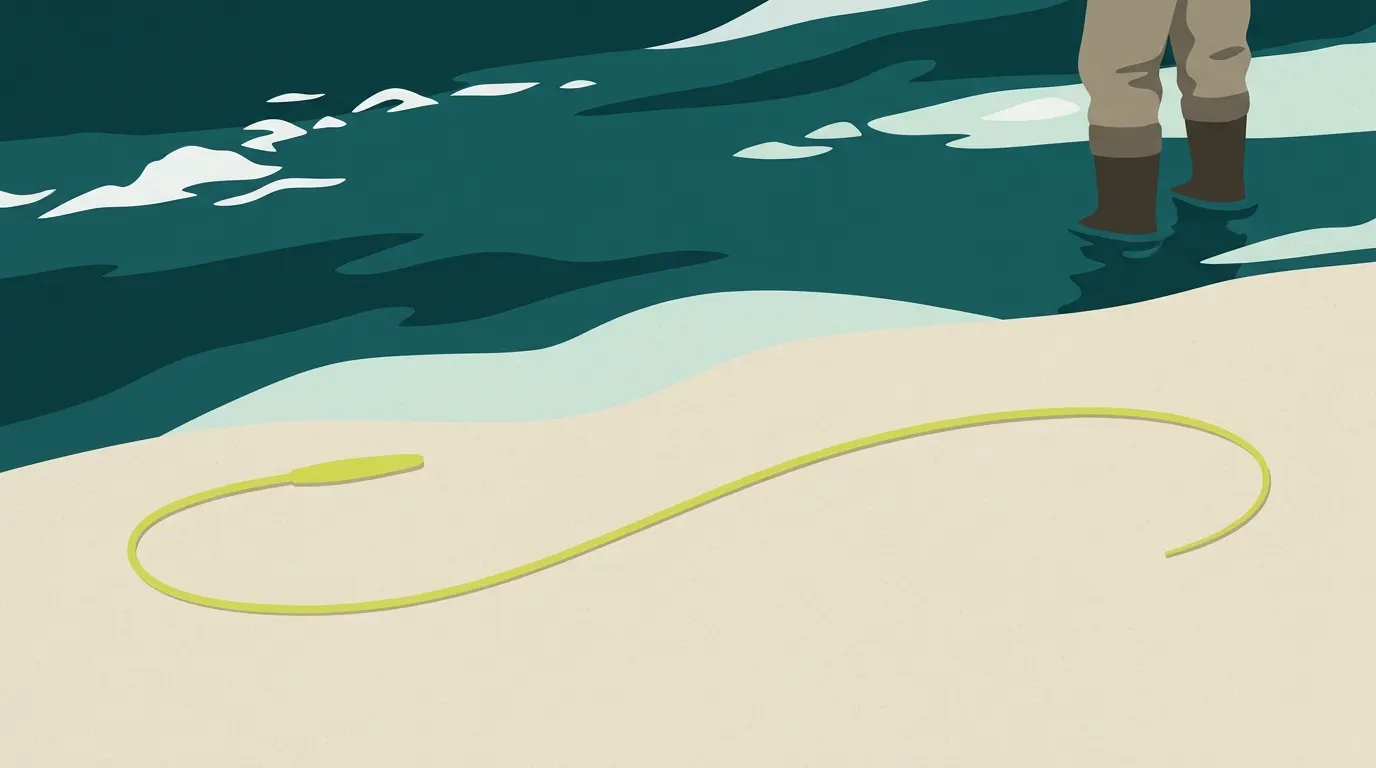
Scandi heads are longer and lighter. Fly and Field gives 35 to 45 feet, with a long front taper "for delicate presentations." Big Sky Anglers, again for trout spey, lists 20 to 32 feet and the same 150 to 375 grains, so the length figures differ between sources. Treat both as ranges, and read the maker's number on any head you buy.
Scandi's job is quiet delivery. Big Sky Anglers says the long front taper and light front end give a smooth, delicate delivery that relies on line speed, and that leader choice matters a lot: a 10 to 16 foot tapered monofilament leader, or the lightest coated tapered leaders. Fly and Field says Scandi heads carry heavy tips and flies less well, suit small flies and surface or shallow presentations, and are usually paired with polyleaders.
What counts against it: Scandi heads are more affected by wind, and they are harder to learn because they need a long, smooth casting stroke. Fly and Field says they perform best on longer, full spey rods.
Skagit vs Scandi at a glance
| Skagit | Scandi | |
|---|---|---|
| Head length (Fly and Field) | 15 to 25 ft | 35 to 45 ft |
| Head length (Big Sky Anglers, trout spey) | 12 to 20 ft | 20 to 32 ft |
| Front taper | Short | Long |
| Tips | Heavy sink tips | Polyleaders, light tips |
| Flies | Large, weighted | Small, light |
| Wind | Easier | More affected |
| Learning curve | Easier | Harder |
The two sources give different lengths, and one is about trout spey while the other covers spey lines in general, so read the figures as ranges. (A head length in a table describes a category. The line you buy has a specific number printed on its box, and that is the one that counts.)
The hybrid
Many trout-spey lines fall between the two. Big Sky Anglers describes hybrid heads at 22 to 28 feet and 150 to 350 grains, with a front taper between Skagit and Scandi and a front end heavier than most Scandi heads but lighter than Skagit. It says they handle unweighted and weighted wet flies and small to medium streamers at various depths, and that coated tapered leaders work best, because tapered monofilament tends to feel "slappy" or "clunky." It also says they cannot turn over heavy T8-type tips.
If you fish one river with one rod and do not want to buy two lines, a hybrid is the compromise. If you know you will throw heavy tips, buy a Skagit. If you know you will fish small flies in low water, buy a Scandi.
Choosing by water and season
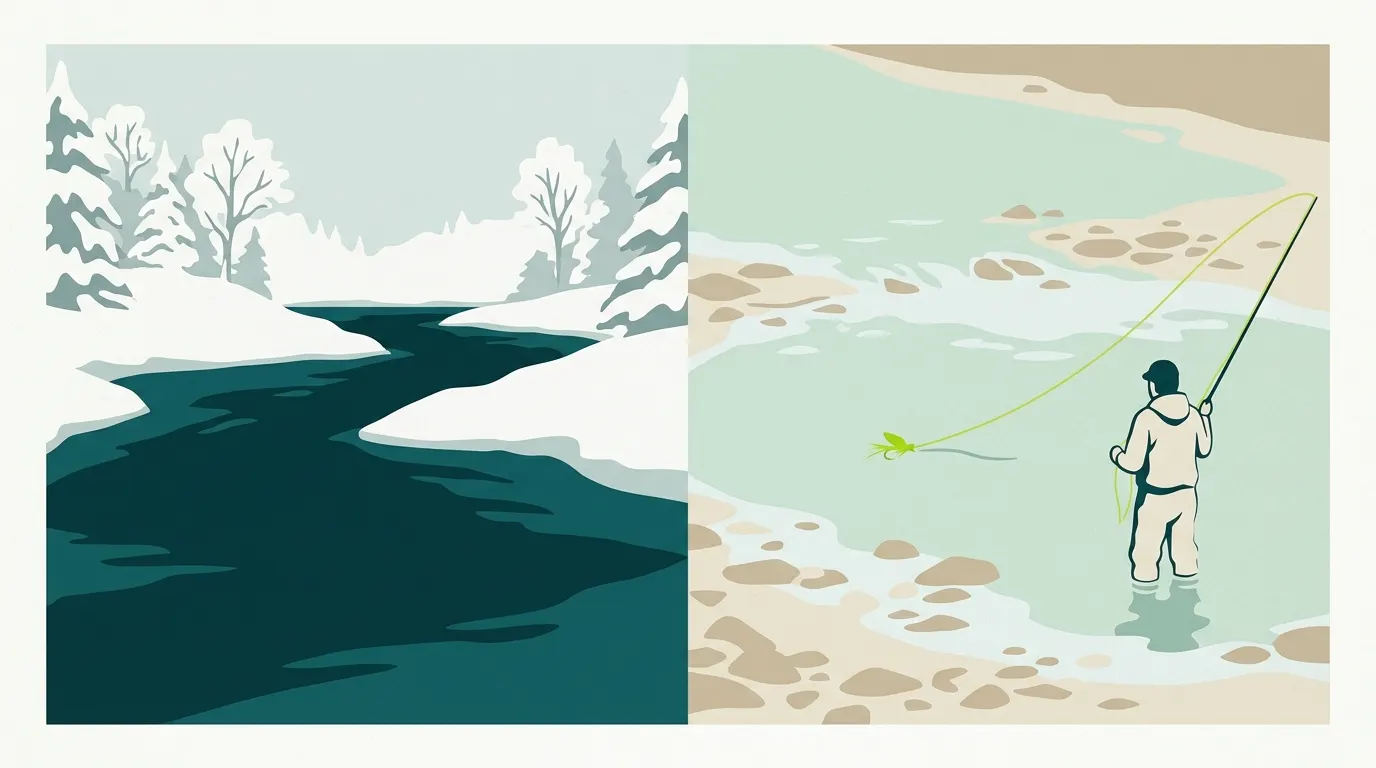
Fly and Field gives a rough map. Skagit suits high-water winter steelhead, and in lower water, dry-line fishing in late summer and fall. Scandi suits clear low water in late summer and fall, and summer steelhead. Our fly fishing for steelhead guide quotes a shop that describes Skagit heads as a sink-tip delivery system and Scandi heads as full floating shooting heads, and fly fishing for salmon covers the same lines for Atlantic salmon.
Match the rod too. A head is chosen by grains, and the rod's maker gives a window. Fly and Field says grain windows generally span about 50 grains, and that beginners should favor the heavier end of the window. Our spey vs switch rod guide explains how shorter two-handers change the choice, and what weight fly rod for steelhead covers rod weights.
Which one first
MeatEater advises a beginner to start with one middle-ground spey rod and one type of spey line, which it names as the Skagit head, shorter and heavier than most spey lines and so easier to manage. It suggests 10 to 12 foot rods for starting out. I would follow that. Learn one line properly before buying a second. The cast is a sequence, and a second line only adds a second set of variables.
For the vocabulary of grains, weights and tapers, see types of fly line and the fly line weight chart. To browse what is on Amazon US, start at fly lines.
Questions people ask
What is the difference between Skagit and Scandi lines?
Mostly length and taper. Fly and Field puts Skagit heads at 15 to 25 feet with a long body and short front taper, and Scandi heads at 35 to 45 feet with a long front taper. Skagit throws heavy tips and big flies; Scandi suits small flies and delicate presentations.
Which is better for beginners, Skagit or Scandi?
Skagit, according to Fly and Field, which calls it easier to learn and easier to punch through wind. It says Scandi heads are harder to learn and need a long, smooth casting stroke. MeatEater also calls Skagit heads shorter and heavier than most spey lines, which makes them easier for beginners to manage.
Can I use a Skagit head on a Scandi rod, or the reverse?
Rod and head have to be matched by grain weight, not just by label. Fly and Field says Skagit heads suit switch and single-hand rods and Scandi heads perform best on longer full spey rods. Check the maker's grain recommendation for your rod before buying.
What is a hybrid spey line?
Big Sky Anglers describes a hybrid as sitting between the two, with a front taper between Skagit and Scandi and a front end heavier than most Scandi heads but lighter than Skagit. It says a hybrid cannot turn over heavy T8-type tips.
Which line is best for winter steelhead?
Fly and Field says Skagit heads suit high-water winter steelhead, and Scandi heads suit clear, low water and summer steelhead. See our steelhead gear guide for how the rest of the setup fits together.
Save this guide for later
Sources
- Fly and Field: A brief introduction to modern spey lines — accessed 2026-10-15
- Big Sky Anglers: Trout spey lines explained, Skagit, Scandi and hybrid — accessed 2026-10-15
- MeatEater: How to get started spey casting — accessed 2026-10-15